Overview
2-7 Triple Draw is a lowball draw poker game where the lowest hand wins and players get three chances to improve their hand. Aces are always high (bad), and straights and flushes count against you. With four betting rounds and three draws, patience and draw-counting are key skills.
Number of Players
2–6 players. A standard 52-card deck is used — no Joker.
The Object
Make the lowest possible 5-card hand. Aces are always high (bad). The best hand is 7-5-4-3-2 in mixed suits.
Key Rules: Aces are always HIGH — they are the worst card. Straights and flushes DO count against your hand. 7-5-4-3-2 in mixed suits is the best possible hand — it avoids both a straight and a flush.
Blinds
2-7 Triple Draw uses a small blind and big blind, posted before the deal — just like Texas Hold'em.
The Deal
Each player receives 5 cards face-down. Players look at their own cards only.
Betting & Draw Structure
The hand proceeds in alternating betting and draw rounds:
- Bet #1: After receiving your 5 cards
- Draw #1: Discard any cards and draw replacements
- Bet #2: After the first draw
- Draw #2: Discard and draw again
- Bet #3: After the second draw
- Draw #3: Final discard and draw
- Bet #4: Final betting round
- Showdown: Lowest hand wins
The Draws
On each draw, players may discard 0–5 cards and receive the same number of replacements. Keeping all 5 cards (standing pat) signals a very strong hand — opponents will notice and adjust accordingly.
Comparing Low Hands
To compare hands, start from the highest card — lower is always better. Straights and flushes rank worse than unpaired hands:
- 7-5-4-3-2 (no flush) beats 7-6-4-3-2 (both 7-high, but 5 beats 6)
- Any unpaired, non-straight, non-flush hand beats any straight, flush, or paired hand
- Ace is always high — A-2-3-4-5 is not a straight but merely an ace-high hand; it's a bad hand solely because the Ace is high (it loses to king-high)
- Among paired hands, the lower pair is better (2-2 beats K-K in lowball)
Triple Draw vs. Single Draw
- Weaker starting hands are more viable — you have three chances to fix bad cards
- Starting with an Ace is a setback, but not fatal — you can dump it on draw #1
- By Draw #3, you should be drawing 0 or 1 card — drawing more signals trouble
- Standing pat early (Draw #1 or #2) is a powerful signal — bluff or genuine strength
- Count how many cards opponents draw each round — this is critical information
Strategy Tips
- Discard Aces immediately — they are worthless in 2-7
- Keep any four cards that are 8 or below (and not four of the same suit)
- Avoid keeping 2-3-4-5 and drawing for a 6 — that makes a straight!
- By Draw #3, stand pat on any 8-low or better
- If an opponent stands pat on Draw #1, expect a 7-low or 8-low; fold or bluff-catch carefully
- Bet and raise aggressively after reaching a strong low — use draw-count information
Example Hand
You hold 


 . Draw #1: discard J♠ Q♣ → draw
 . Draw #2: discard A♠ K♥ → draw
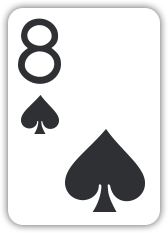 . Draw #3: discard 8♠ → draw
  — 7-5-4-3-2, the best possible hand!
