Overview
Chicago, also known as High Chicago, is a seven-card stud variant where the pot is split between the highest hand and the highest spade in the hole (face down). This creates an additional strategic element where players compete for both the best poker hand and the best hidden spade.
The Split Pot
- Half the pot goes to the player with the highest hand
- Half the pot goes to the player with the highest spade in the hole (face down)
- The same player can win both halves by having the highest hand AND the highest face-down spade
Important: Only spades that are face DOWN count toward winning the spade half of the pot. Face-up spades do NOT count, even if they are high cards like the  .
.
Ante & Bring-In
As in Seven-Card Stud, there are no blinds. Each player posts a small ante before the deal. After the first three cards, the player showing the lowest upcard must open with the forced bring-in bet (suit order — clubs, diamonds, hearts, spades, lowest to highest — breaks ties). That player may post just the bring-in or complete it to a full bet; going around the table, any player may fold, call, complete to a full bet (if no one has yet), or raise.
The Deal
Identical to Seven-Card Stud:
- Third Street: Two cards face down, one card face up
- Fourth Street: One card face up
- Fifth Street: One card face up
- Sixth Street: One card face up
- Seventh Street: One card face DOWN
Betting Rounds
There are five betting rounds:
- After third street (two down, one up)
- After fourth street
- After fifth street
- After sixth street
- After seventh street (final card)
Betting Order
On third street, the player with the lowest upcard posts the bring-in and opens the action. From fourth street on, each betting round is begun by the player with the highest hand showing (based on visible cards).
Declaration
After the final betting round, all active players must declare their intentions:
- High Hand: Going for the highest hand
- Spade: Going for the highest face-down spade
- Both: Going for both halves
Declaration Rules
Critical Rule: You must have at least one spade face DOWN to be eligible to win the spade half of the pot. Without a face-down spade, you cannot declare spade and win, even if all other players are going for high hand only.
Winning Both Halves
If you declare "both" (highest hand and highest spade), you must win both halves — the highest hand AND the highest face-down spade — to win anything at all. If it turns out you won only one, you forfeit that half too and take nothing; it passes to the next-best player who declared for it. This "win both or win nothing" rule (often called the "pig") is what makes declaring "both" a genuine gamble rather than a free extra chance.
Example Scenarios
Scenario 1: If the is dealt face UP to any player, then the 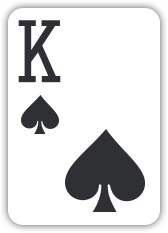 in the hole (face down) is guaranteed to win the spade half of the pot, assuming its owner declared spade.
Scenario 2: You have  face down and
  face down. All visible spades are lower than . You have a strong chance to win the spade half, and if you also have the highest hand, you can declare "both" and scoop the pot!
Declaration Methods
Declaration can be done in one of two ways:
- Sequential: Starting to the left of the dealer, each player declares in turn
- Simultaneous: All players declare at the same time using chips (one chip for high, two chips for spade, three chips for both)
Why Sequential Declaration Matters
The declaration method looks like a footnote, but for the sequential version it is the strategic heart of the whole game. Declaration happens after the final bet, so it changes no wagering — it only decides how an already-finished pot is split. Under simultaneous declaration (chips hidden in the fist), no information passes between players, so it plays almost exactly like "cards speak": the best hand takes the high half, the best face-down spade takes the spade half, and declaring "both" is simply the pig gamble.
Sequential declaration is different because you can see what every player before you declared. If you are last to act and everyone ahead of you has declared high, the spade half is now uncontested — you can declare spade and claim it with any face-down spade at all, even a low one, because no one else is competing for it. A near-worthless  in the hole can win real money this way. The whole sub-game lives on the spade axis: the high side is mostly face-up and easy to read, while nobody knows who holds the best hidden spade until the declarations travel around the table.
The flip side is the danger of declaring too early. The player holding the top face-down spade who declares high — chasing the scoop, or misreading the table — can hand the spade half to someone with a far weaker spade who declared into the gap. Under "cards speak" the best hidden spade always wins that half; under sequential declaration, it does not have to. That gap between "best cards win" and "best-declared cards win" is the entire game the declaration adds.
Key Strategic Elements
- Pay attention to which spades are dealt face-up - they're dead for the spade pot
- A high face-down spade gives you an additional way to win
- If you don't have a face-down spade, you can only compete for the high hand
- Watch opponents' upcards to gauge if they have face-down spades
- Consider your declaration strategy based on your hole cards
Strategy Tips
- High spades in the hole are extremely valuable in Chicago
- Track which spades have been exposed face-up to know what's still available
- If you catch a high spade face-down late in the hand, consider going for the spade half
- Pairs combined with a high face-down spade are premium starting hands
- Even a small face-down spade can win if all higher spades are exposed
- Be cautious about declaring "both" unless you're confident in both your hand and your spade
